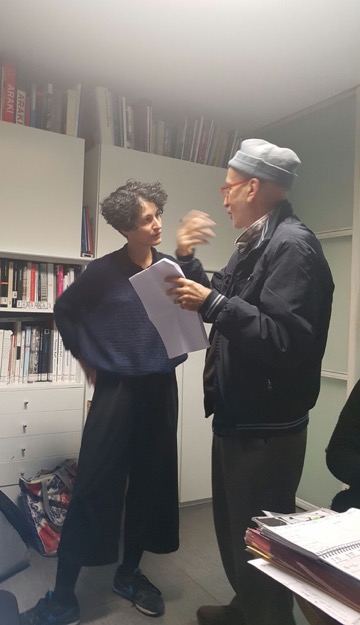
First encounter with Piero Cannata. In gallery Dryphoto Arte Contemporanea, Prato. November 2016
I contacted Piero Cannata three years after the curator Alba Braza explained me that she knows him. He is a sporadic visitor of Dryphoto Arte Contemporanea in Prato (Italy), a gallery where she works for a specific project that takes place every November.
When thinking about what Alba Braza explained me time ago, I decided that the research project Martellata_14.09.91 would be one of the main components of my doctoral thesis Behaving Unconventionally in Gallery Settings. It motivated me to continue inquiring into understanding the plurality of functions that artworks perform, the different attitudes and relationships that they generate, and the conflicts that also arise between or out of them. But first of all I had to agree about my intentions with Cannata.
After a few inquiries and some coordination, I managed to meet him in November 2016. We held two long conversations; the main objective was to approach his particular reality[1] and to create a bond of trust and confidence. After talking about ancient and contemporary art -and above all- listening to his achievements as a mathematician and ‘grammatologist’[2], I got his permission for researching the case. After that I asked him a couple of questions. He replied that he gave a soft hammer blow to the statue and that the marble -contrary to what he had imagined- was very soft. Then he explained that with the attack had the intention of announcing that he had created a new Italian grammar.
Contrary to that statement of November 2016, I had already read in an online newspaper that Piero Cannata had declared on September 14, 1991 – immediately after his act – that La Bella Nani by Paolo Veronese had asked him in his recurring dreams to make such a gesture[3]. After the first approach to the case study, I reaffirmed my first objective: to investigate phylogenetically the iconoclastic act. I then set the goal of studying all events, individuals and actants directly and indirectly involved by it. Therefore I coordinated the access to institution’s archives, interviewed professionals and studied “objects of information inscription”, understanding that matter -through its alterations of state, transformations and accidents- stores memory and also points to the events that have taken place.
Therefore, in the course of 2017 – 2019, during the data compilation phase, I accessed the archives of: Consiglio Nazionale delle Ricerche, Opificio delle Pietre Dure i Laboratori di Retauro, Tribunale Superiore di Firenze, Gipsoteca dell’Istituto d’Arte di Firenze, Fondazione Michelangelo Buonarroti, and Biblioteca Nazionale Centrale di Firenze. I also met Piero Cannata and different professionals such as Franca Falletti (director of the Galleria dell’Academia during 1992 – 2013), Angelo Tartuferi (current scientific expert and deputy director of the Galleria dell’Academia), Marzia Marigo (secretary of the archive of the Galleria dell’Academia), Cinzia Parnigoni (restorer), Susanna Bracci (scientific restorer of the CNR), Fabio Fratini (scientific restorer and geologist of the CNR), Annamaria Giusti (art historian and director of restoration of the OPD), Luigi Davitti (cast technician of the Gipsoteca). In addition, in the summer of 2018, I visited the different external and internal quarries of Carrara, its workshops (including the Michelangelo and TorArt Laboratories), the marble technical schools with their directors and teachers, as well as the museums and art centers of Carrara.
On the other hand, and after a second meeting with the restorer Cinzia Parnigioni in July 2018, I verified that two of the seven fragments detached from the sculpture were used for crystallographic and petrographic analyses[4]. The scientific information obtained by the Consiglio Nazionale delle Ricerche (CNR) was decisive for two key aspects about the David: 1) the identification of the extraction site of the block in Carrara: the Fantiscritti quarry; and 2) the preservation state of the sculpture: it became evident that the marble was cotto. The fact that the stone had lost its initial chemo-crystalline properties and that, therefore, was very fragile, determined and indicated the action of the general restoration of the sculpture during 2002-2004.
Subsequent to the second encounter with the restorer Cinzia Parnigoni, I understood that the formalizations of Martellata_14.09.91 had to be the result of a dys-position[5]. That is to say, an initial chronological disorganization of all points of view on the event that would set up a dialogue between the different spaces, times, subjects and agents involved, so to generate a plot of comprehension about ‘the attack’ that, as mutivocal stories, would shape the artistic outputs.
When in November 2018 I accessed the files of the Opificio delle Pietre Dure e Laboratori di Restauro, I found the photograph taken by the restaurateur Roberto Nesti that documents the seven marble fragments. The enclosed technical sheet describes that the smallest piece had the size of a coffee bean, and the largest the dimensions of an almond. Neither that photograph, nor the technical sheet, nor the article published in the OPD magazine in December 1991, documented how much powder was also detached from the sculpture, although the article mentioned that some was generated. What the texts definitely did not point out was the release of marble micro-particles in the air, as a result of the attack.
Micro-particles are solid fragments that, due to their tiny size, are invisible to the human eye. They can vary in their behaviour: for example, those higher than 125μm could take 10 years to touch the ground while those below 90μm would be suspended in the air almost forever.
Intrigued by the lost and undocumented powder, I also started to enquire about ‘the nature of the powder’ its differences with dust and with micro-particles. I even carried out an electromagnetic granulometry (a grain size classification) at the Sedimentology Department of the Faculty of Geology of UAB. Sieving a sample of sand taken at the Fantiscritti quarry, helped me to understand a bit further what characterizes powder and its grains, what are its particularities and how I could work with such material.
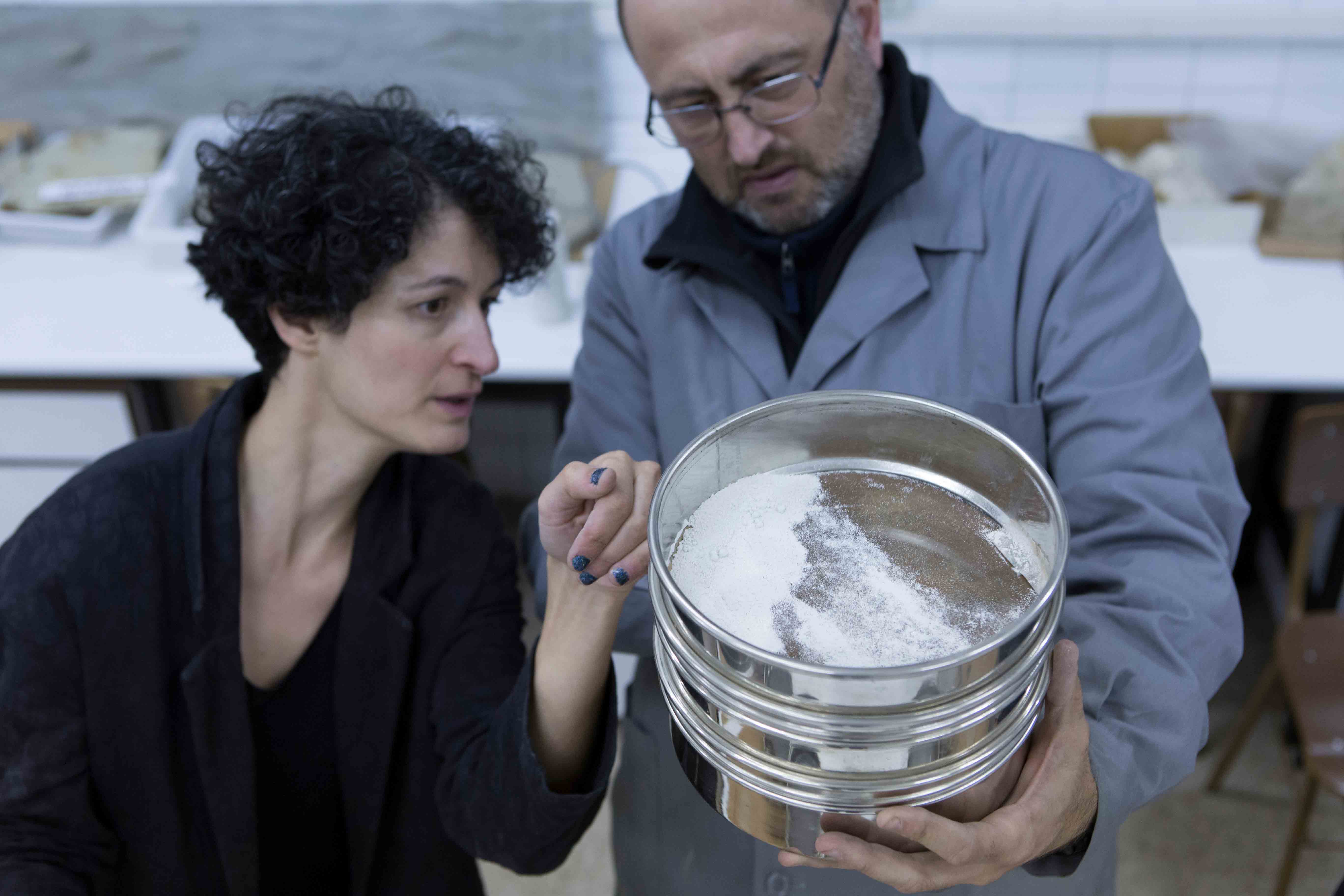
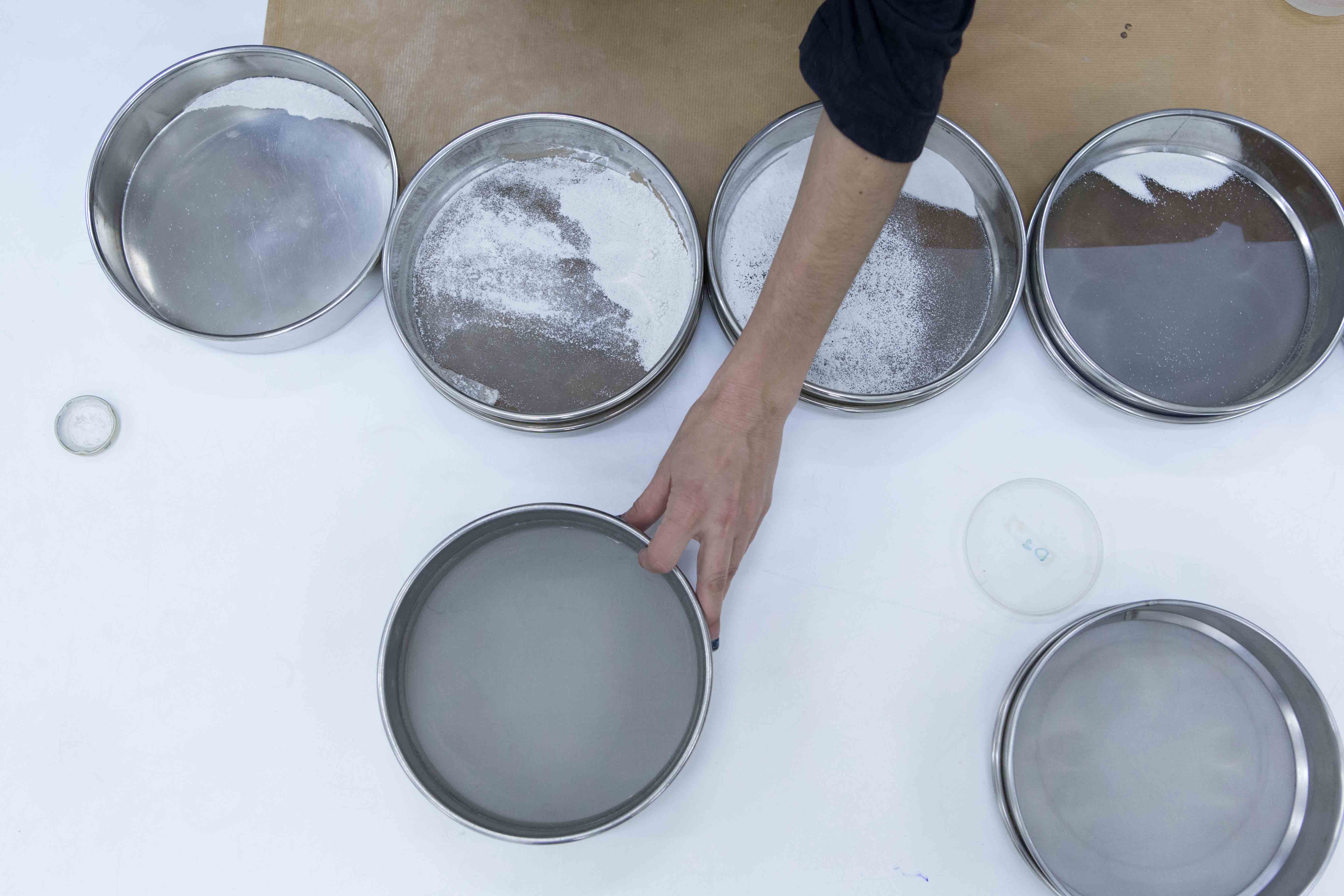
Granulometry with Dr. Oriol Oms. At the Sedimentology Laboratory in the UAB, Universitat Autònoma de Barcelona
On the other hand, at the end of 2018 I also contacted Dr. Anu Kaakinen and the researcher Katja Bohm from the Air Erosion Unit of the Geology Department of the University of Helsinki. They advised and assisted regarding the inquiries related to the marble powder, its sizes, constitution and behaviors. We also agreed on future collaborations.
Since the beginning of April 2019 I am in conversations with the curator Ulla Taipale, for a visit and possible involvement of INAR, Institute for Atmospheric and Earth System Research.
–
[1]Piero Cannata is schizophrenic and suffers episodes of delusional disorders; he is not aggressive even though he is obsessive. When I meet Piero Cannata in November 2016, I do not know that precise information. I know by then that he had been admitted to the penitentiary psychiatric institution on several occasions. I read the diagnosis in November 2018, when I access the report of the surgical specialist in psychiatry Dr. Sandro Ventura, Relazione di consulenza psichiatrica nel contenzioso promosso nei confronti di Cannata Piero. N. Di Ruolo Generale 4309/06 – N. Di Ruolo Sezione 4508/06 which is in the Fascicolo 1291/07 – Arch. N. 1230/09 of the Criminal Code File of the Superior Court of Florence.
[2]Cannata in consiglio: “Mi occupo di grammatica e nessuno mi sta a sentire” https://iltirreno.gelocal.it/prato/cronaca/2016/03/17/news/cannata-in-consiglio-mi-occupo-di-grammatica-e-nessuno-mi-sta-a-sentire-1.13143934?ref=search
[3] After a first research at the hemeroteque of the National Library of Florence [November of the 2017 and of the 2018], I verify that the majority of Italian newspapers with date 15.09.91 contain that same affirmation: “Doveva farlo, doveva farlo […] E ‘a storia di spiriti … E’ stata a beautiful signora from ’50, the beautiful Nani del Veronese, a chiederme questo. Sapete, ogni so much the vedo in sogno. “La Bella Nani is a portrait of Veronese of a Venetian lady, painted around 1560, which today is in the Louvre Museum. https://en.wikipedia.org/wiki/La_Bella_Nani
[4] I am referring to the studies Controlli analytical chimico -fisico sui frammenti di marmo provenienti dal dito del piede sinistro coordinated by Donato Attanasio (1991) and Caratterizzazione mineralogico petrografia e fisica del marmo by Fabio Fratini (1991) which were later compiled in the book Exploring David. Diagnostic Tests and State of Conservation. Prato: Giunti Editore, 2004. Pgs. 130-135
[5]To dys-pose things would be a way to understand them dialectically, to disorganize their disposition or order of appearance. The ancient Greek verb dialegestai means to controvert, to introduce a difference (dia) in the discourse (logos). DIDI-HUBERMAN, Georges. When The Images Take Position. Madrid: Antonio Machado Books, 2008
–
– Report Travel Grant, 2017
– Report Travel Grant, July 2018
– Report TTOR grant, 2018