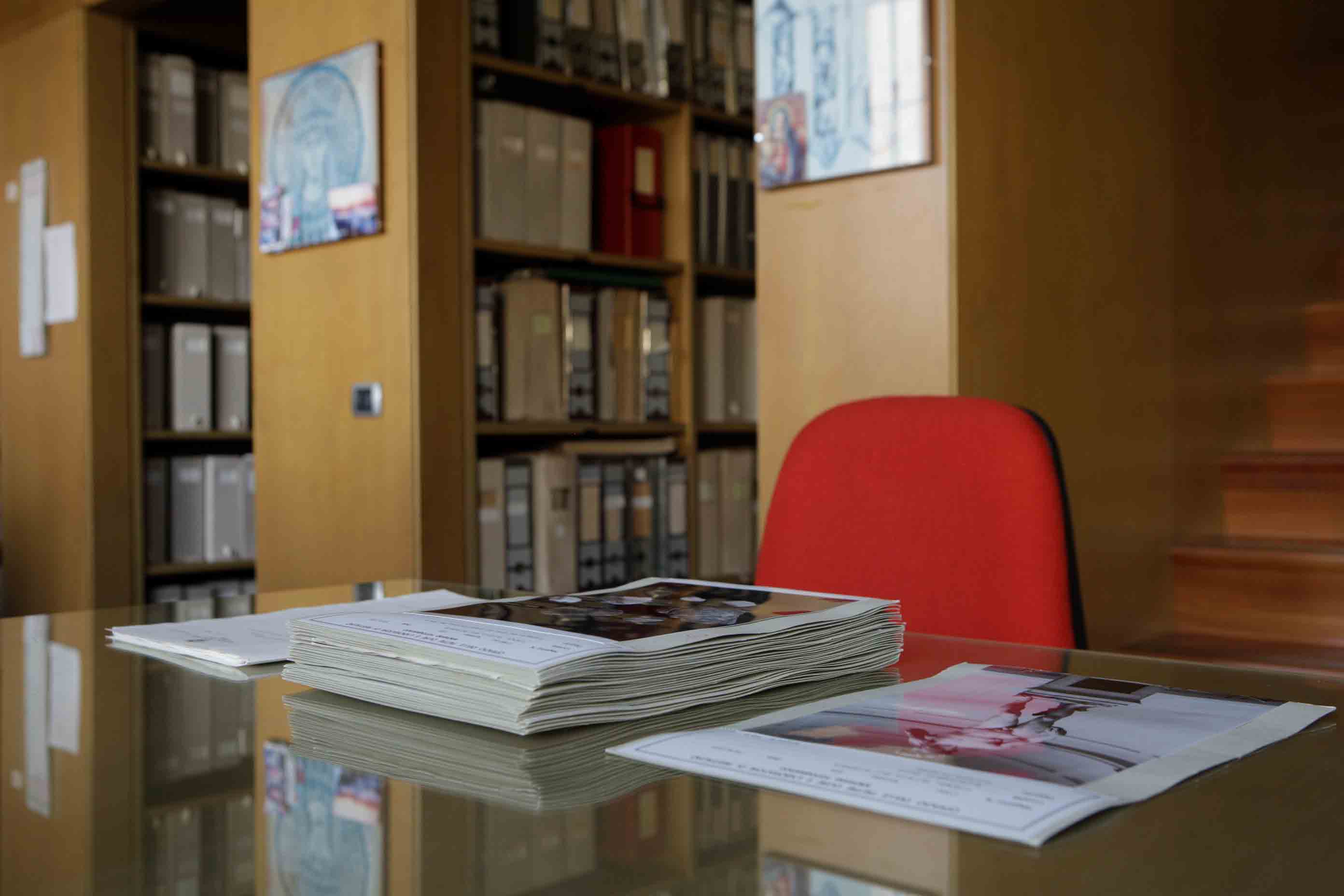
Martellata Publication

  • Examples of some tests of texts, narrating ‘the attack’ from all actant’s perspectives:

    THE FIRST TIME
    It was a sunny and busy morning of July. I was nervous waiting for Franca Falletti and, as usual, I was stressing out myself. … I was regretting for not having checked out earlier further information about her career – as if I would have had that much time!

    It was actually good to be in Italy for the project and the Research Pavilion in Venice. I felt that it gave me credibility in order to start a project in anew country where no one knew my work.

    After a short while, which felt very long, and a couple of SMS, I saw her arriving. She was dressed in casual and fresh clothes. That, and the fact that she was late, made me feel good. I got the impression that she was an approachable person, and yes indeed, she was .

    After a short introduction, we decided to go into a bookshop for a coffee. There Franca asked me about my interest on the attack. I tried to explain her in my poor and mistaken Italian my general interests, two of my previous works, and the reasons for my new project. I wondered about what she understood and I was surprised about her patience for following up what I was saying.

    It seems that she did get something, as we went inside the Galleria dell’Academia after that bad coffee in the touristic bookshop. I still like how we entered the gallery, sneaking in through the exit door. Franca talked briefly to a female guard to later call the secretary. After briefly explaining to Francesca the motives of our visit, we went towards the rooms. I was still quite nervous and I got very excited.

    I was surprised by the fact that no memories came back about that first visit during the high school trip in 1996. I remembered much more The Uffizzi galleries. Did we visit the David at all?

    One way or another, there it (he) was, surrounded by a hundred of tourists that seemed more worried about a selfie than the masterpiece itself. I thought it was a miserable scene. That was one of the first aspects that Franca pointed out.

    We observed the sculpture and the whole seen for a while. Then I thought it was the moment to start making questions. I had many: Where you at the Galleria when the attack happened? How where you informed about it? Can you recall the guard that was in the room that day? What happened immediately after Piero Canatta dealt the hammer blow? What materials where detached from the sculpture? How where the pieces collected? Was there any dust in the room?

    After I pronounced the first one, I was shocked by the fact that she –as the former director of the Galleria dell’Accademia– could not describe the details of that 14th of September 1991. She mentioned that was at her office when the martellata happened, but couldn’t recall the guard or how the restorers did their primary job.

    I could imagine that, in her position, she could not mind about some specific aspects. Probably there were different urgent questions to take care of; all at once. Like calling the police and then immediately contacting the restorers from the Opificio delle Pietre Dure e Laboratori de Restauro.

    … But was she keeping some meaningful information as we just met? Furthermore, why did she referred to the attack as “the accident”?

    I thought that in the future I would find out about the particularities. That was only a previous meeting, and it was just getting interesting!


    FLORENCE POLICE STATION
    Object:
    Report of seizure of: n. 1 hammer of gr. 200 with wooden handle
    charged to: CANNATA Piero, born in Bompietro on 14.12.1947 and residing in Prato


    SCIENTIFIC POLICE CABINET
    Section inspections
    nr. Q2 / 0026472 of prot.
    In the year 1991, on the 14th of September, from 12.30pm to 2.00 pm in Florence, we scientific agents scriptwriters Froncia Antonello and Bandinelli Stefano, technical operators involved at the Regional Scientific Police, at the Police Station of Florence, at the request of the UCT, we went to the Galleria dell’Accademia, in the via Ricasoli n.60, to execute the technical aspects related to the apprehension of Cannata Piero.

    On the statue there is a fracture of an anterior portion, of the third phalanx of the second finger, of the left foot. This rupture has left exposed a surface of white marble, of a circular form.


    INTO SUGAR WE COULD HAVE TURNED
    Shocking it was
    Very bright, blinding light around
    Our orientations we lost

    Being shot, by an acushioned bang
    Spining, autorotating we were
    Sick, lonely, missing something.
    What was that coldness?
    Oh, that strong light!

    The speed calmed
    Smoother the spiral movement turned
    Oh, our burning eyes!

    A new strange feeling.
    What was that?
    We could not describe

    Now, 28 years after, we understand.
    This, a long time for us is not.

    The acushioned bang, echoing, hollow
    When Michelangelo sculpted,
    Vibrant, crystallized the sounds were

    What was that?
    Conversations from scientists we heard.
    When to talk to Director Falletti they came
    Into sugar we could have turned
    Marmo zuccerino, they said.

    Weathering had made this thing
    For 300 years the sculpture was rained
    Taròli, problematic they seemed to be
    These are the small holes the sculpture has

    The tickling feeling we liked
    The water running down
    Oh our minerals, so refreshed they were!

    Now, part of the thin air we are
    And now, so small, we caress the space


    WE HAVE A LONG HISTORY, BUT ARE CONTEMPORARY
    Not being affected by the gravity is fucking hard. Most of the humans dream of being light, able to float and move as if nothing, with the least effortless gesture. But no, they do not really know what they mean.

    When something or someone moves near you, you wanted or not, are dragged by the air that this something or someone has displaced. Sometimes it’s a simple swing, like a light breeze, but there  are moments that it’s a real hurricane, with gales that come and go in different directions. This is exactly what happens on the busiest days, such as the last Sundays of each month – so, today.

    In just 15 minutes, from 4:53 pm to 5:08 pm; I went from Sala degli Orcagna to the hall of the13th and 14th century painters, from the 13th and 14th century painters’ hall, to the bookstore, from the bookstore to the corridor, from the corridor to the galleria dei Prigoni, from the galleria dei Prigoni to the sala del Colosso, from the sala del Colosso back t to the the shop, from the shop (and without going through the corridor) again to the galleria dei Prigoni and from galleria dei Prigoni to the Tribuna di David. It seemed that I was going out of from the Tribuna di via the galleria dei Prigoni, but I was returned there. Now I have circled the famous sculpture eleven times; in different directions! I am tired of this!

    Why would that damn baker’s apprentice come to visit  here three months ago? At least it could have been on a windy day and he would not have dragged me to this madhouse. If at least one swallow would had gobbled me in its search for aerial insects! But no, here I am among these marble micro-particles who consider themselves exceptional. How much I miss my warm and friendly companions! Yes, filled with gluten, but always laughing! Instead, those are cold and arrogant, and what is even worse, antiquated… Who can understand the 15th century talking?

    We, the micro-particles of spelt, also have a long history, but are contemporary!

    I was harvested last year at the Alta Valle del Serchio in Garfagnana; not as those old ladies. Of course, they themselves knew, but humans could not trace in any document or certificate from which quarry of Carrara the marble block was extracted . A schizophrenic  man had to come to break a toe of the sculpture so that scientists could make those petrographic and crystallographic analyses to figure it out.
  • After three years of thorough study of all actants[1] (human and non-human agents) compromised by the attack, Martellata has the objective of compiling all events directly and indirectly (inter)linked to the iconoclastic gesture to the David; aiming to generate a complete and comprehensive story of the vandalistic act. Such story will be a result of a dys-position[2], of an apparent chronological disorder of the different (inter)details involved. This acronological presentation of the different perspectives of the event establishes tactics of arrangement and analysis of the act of Piero Cannata from the multivocality; avoiding a representational analysis of his act, beyond a description of the damage to the David, further than our epistemological coordinates.

    Escaping the accumulative logic of the archive, the book will gather, review and activate the different voices and perspectives of the actants while establishing dialectical and chrono-material relations between all the components of the publication itself. It will present within different narratives, the most important documents and information compiled during the period of investigation; also relevant insights of the other outputs of the project.

    The process of writing and relating all materials will require testing a narrative style between essay, magic realism prose, and documentation, which beyond art history, will also adopt and adapt knowledges from psychiatry, justice and law, restoration, geology, and speculative fiction; among others. A reference for an engaging conversational narration; navigating between history, autobiography, documentation and fiction is The Expedition by Bea Uusma[3].

    It is the first occasion, after editing and publishing books, that a work requires narrative skills. Therefore Míriam Cano (writer and poet) and Michael Lawton (Doctor of Fine Arts, painter and writer) will supervise the process. Examples of the first experimental texts and a rough selection of the documents can be checked out in the following section.

    The main components of the book will be:
    – Comprehensive interview to Piero Cannata (all questions and interactions with Cannata will be prepared under the supervision of psychiatrist Isabel Valli)
    – Interview to Albertini Nicola, witness of the Cannata’s act (data obtained from the GIP files, at the Superior Court of Florence)
    – Interview to a guard of the psychiatric prison Montelupo Fiorentino, where Piero Cannata was confined during 2000 and 2007 (the direct contact was provided by Radio Papesse)
    – Testimonies of Franca Falletti (director of the Galleria dell’Academia during 1992 – 2013), Angelo Tartuferi (current scientific expert and deputy director of the Galleria dell’Academia), Cinzia Parnigoni (restorer), Susanna Bracci (scientific restorer of the CNR), Fabio Fratini (scientific restorer and geologist of the CNR), Annamaria Giusti (art historian and director of restoration of the OPD), Luigi Davitti (cast technician of the Gipsoteca)
    – Interview to Georges Didi-Huberman. On dys-position; the understanding of an event avoiding the chronological order of appearance of its aspects; the mobilization of the memory in matter, in its fragments and its remains
    – Interview to Dario Gamboni, about the destruction of art and the particular case of Cannata
    – Insights of the different sculptural experimentations: A computerized act of vandalism as a performance, A re-re-copy, Gaps, Clouds of marble dust, and Materiality filters in multiple directions
    – Inclusion of some photographs of the series
    – Reproductions of selected documents from the archives of Consiglio Nazionale delle Ricerche, Opificio delle Pietre Dure i Laboratori di Restauro, Tribunale Superiore di Firenze, Gipsoteca dell’Istituto d’Arte di Firenze, Fondazione Michelangelo Buonarroti, Biblioteca Nazionale Centrale di Firenze
    – ‘Voice’ of the cloud of micro-particles of marble that -because of their small size- would have remained levitating in the Galleria dell’Academia. These micro-particles would have been ‘affected’ and also witnessed ¡the different events’ related to the hammer blow

    The process of inquiry and the formalization of all the final outputs of Martellata_14.09.91 will be published in the Research Catalogue in the form of an exposition. Other journals as TadeoArte and UOC will be considered. A proposal will be submitted to the 11th Annual Conference of the Society of Artistic Research, as a performative talk of the first texts of the book (see an example). The project will be shown at the Exhibition Laboratory of the Academy of Fine Arts of the University of the Arts Helsinki. It will also travel to the Glass Pavilion at Villa Romana in Florence, for later being exhibited in spaces like Sala Muncunill (Terrassa, 2022). I will make performative readings of the book in all venues.

    [1] According to Bruno Latour, the world is like a network of actions whose nodes, sometimes changing, are “actors” or “actants,” that is, “human” or “nonhuman,” respectively. “Translations” (transformations, changes) occur when those actors or actants (who can be human beings, organisms or things) “make do,” that is, make a “difference.” This means that they establish a new course of action, linked to a new stabilization within the network (what was traditionally called a fact or an object). LOREDO NARCIANDI, José Carlos. “¿Sujetos o “actantes”? El constructivismo de Latour y la Psicología Constructivista” in AIBR. Revista de Antropología Iberoamericana 4. January 2009.

    [2] To dys-pose things would be a way to understand them dialectically, to disorganize their disposition or order of appearance. The ancient Greek verb dialegestai means to controvert, to introduce a difference (dia) in the discourse (logos). DIDI-HUBERMAN, Georges. When The Images Take Position. Madrid: Antonio Machado Books, 2008

    [3] Bea Uusma. The Expedition. A Love Story. Solving the Mystery of a Polar Tragedy. London: Head of Zeus, 2014. First published as Expeditionen. Min Karlekshistoria in Stockholm 2013, by Norstedst Forlägsgrupp AB.

    • How to inquire about an act of vandalism beyond the sociology of art and the theories of artistic reception without excluding these?
    • What are the other sources of information, further than archives and individuals? How is the memory contained in the matter? What is the new materialism of dust[1] and which methodologies does one need for mobilizing it?
    • How to escape the archival paradigm as a chronological accumulation in order to generate multivocal narrations that would contain different perspectives (and voices) of what happened, including those related to the materiality of the masterpiece itself?
    • How to renounce the exhibiting values of text (elucidating, explaining) in order to use demonstrative and linking values that are chrono-materially dialectical alongside with the result of the research?

    [1] I refer to the article of Jussi Parikka, 2012. ‘New Materialism of Dust’. Artnodes, (12), p. None. DOI: http://doi.org/10.7238/a.v0i12.1716

  • The project Martellata_14.09.91 follows in the footsteps of a genealogy of works committed to institutional critique. It explores and expands on this tradition by investigating ways in which culture is both embodied and challenged.

    The research essentially follows Carrie Noland [1], who claims that the cultural inscription encourages individuals to modify cultural practices.

    Supporting Stanley Cohen’s assertion about acts of vandalism as “type of reality negotiation”[2], Martellata_14.09.91 aims to find out about the case of Piero Cannata as ‘another (material) way of establishing a relationship’ with the David and art in general.

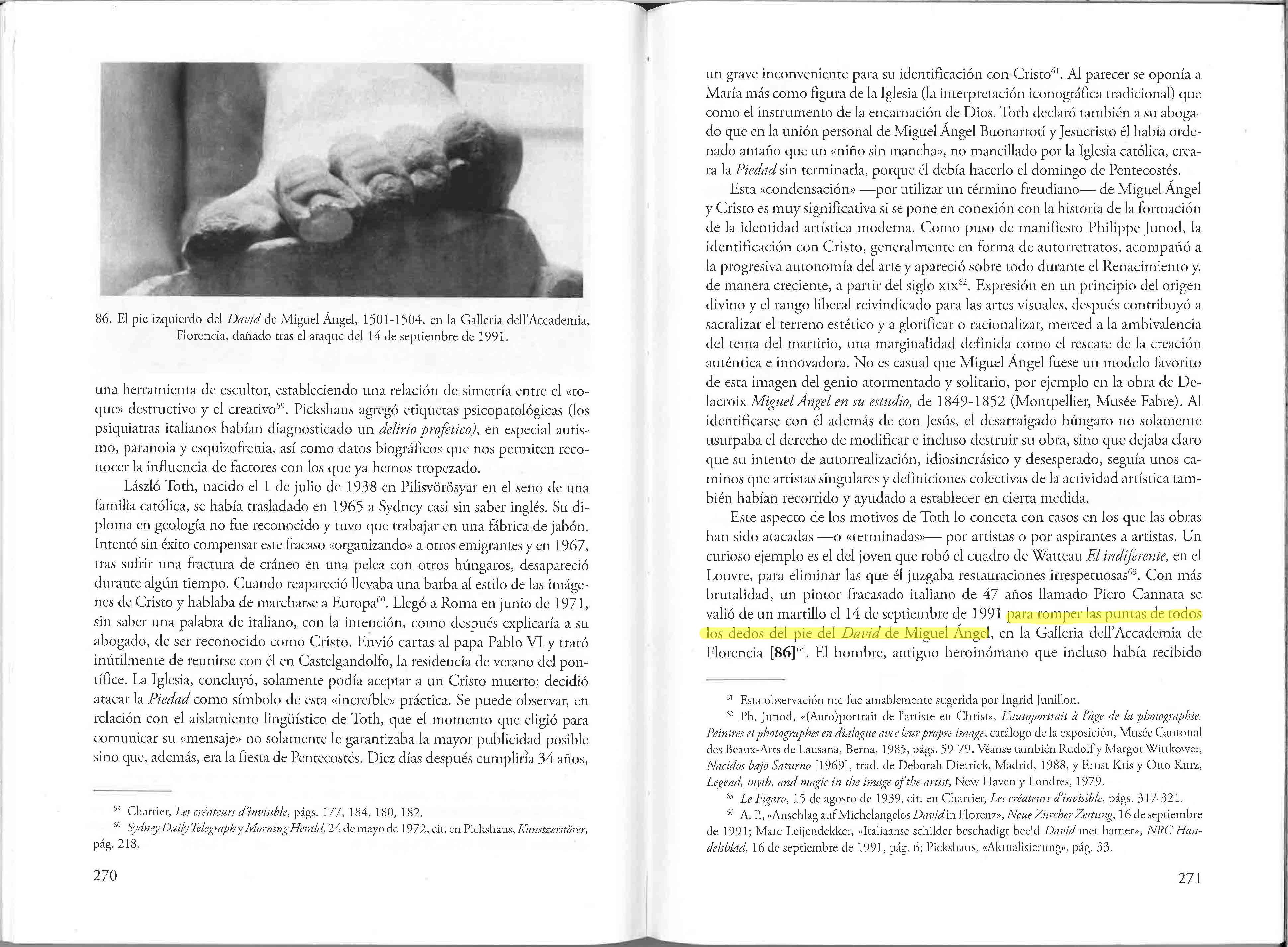
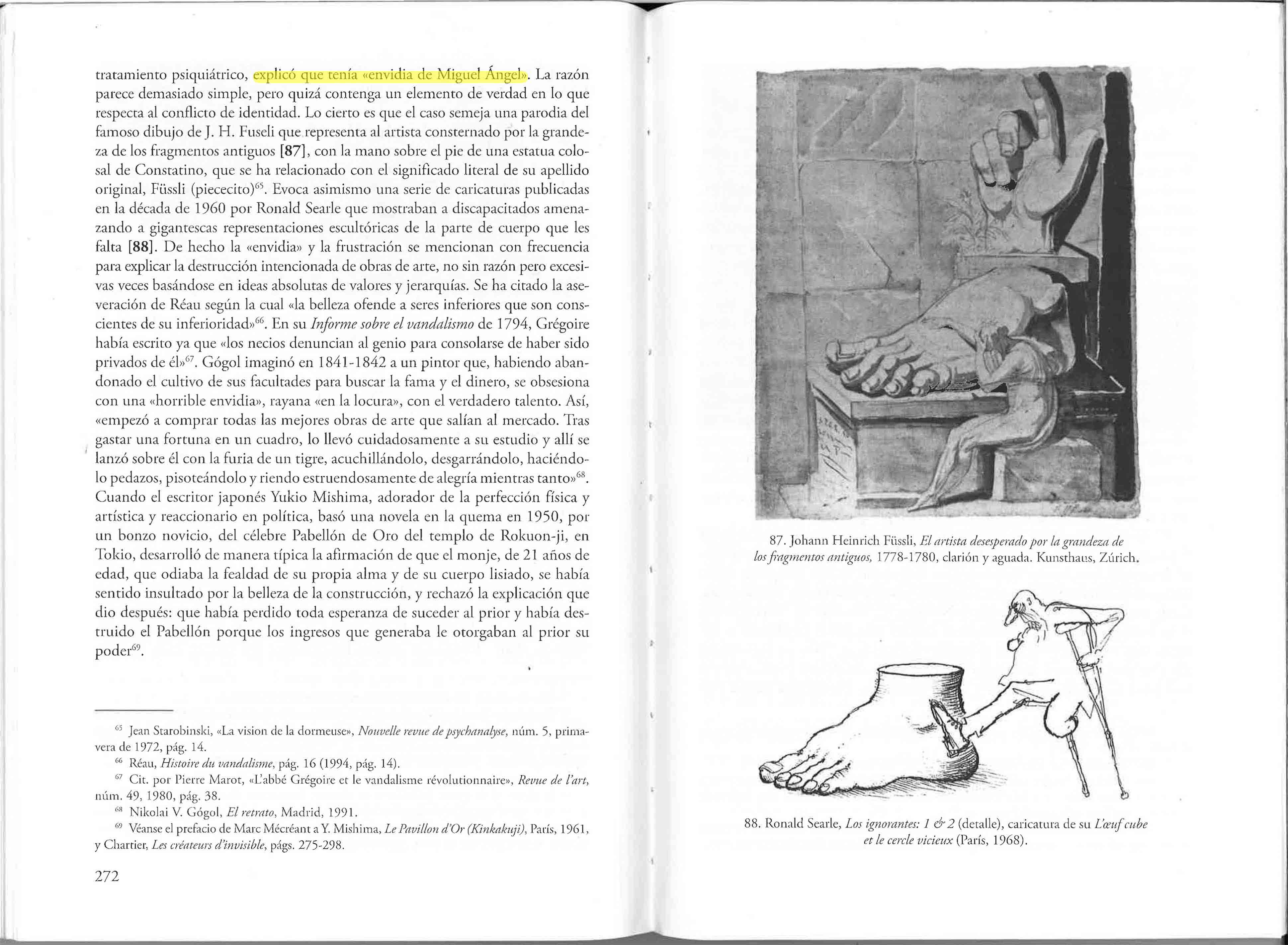
    The research project intends to be a contribution to the theory of response to art, and in particular to vandalism, aligned with the two main authors: David Freedberg and Dario Gamboni. In relation to the latter author and his book The Destruction of Art[3], the publication Martellata aims to correct the errors collected regarding Cannata’s vandalistic act while providing a thorough analysis of it. Dario Gamboni, writes on pages 271 and 272 of its Spanish edition (2014): “Piero Cannata used a hammer on September 14, 1991 to break the tips of all the toes of David” […] “he was envious of Michelangelo”.

    Furthermore, Martellata aims to expand the theories on artistic reception and iconoclasm with a perspective oriented to new materialisms. This focus is mainly motivated by the fact that, among other significant scientific data, relevant information for David‘s conservation was obtained after chemical and petrographic analyses of the sculpture’s fragments F3G, F17G, F18G and F19G[4]. The evidence revealed that the state of the marble of the sculpture is cotto[5] while at the same time confirmed the rumour that the block of stone which was assigned to Michelangelo came from the Fantiscritti quarry in Carrara.

    Finally, as for the context of contemporary art and artistic research, the project intents to be a new view within the growing interest for vandalism that was inaugurated by Bruno Latour with Iconoclash, (Karlsruhe, 2002) and that currently concludes in Venice with the Catalan pavilion Catalonia in Venice. To lose your head (Idols). Providing an approach that generates chrono-material dialogues, it aims to be a counter-point to recent exhibitions that have a repetitive focus on iconoclasm.

    pagina-271_web
    Scan of page 271. Dario Gamboni. La destrucción del arte. Madrid: Cátedra, 2014
    pagina-272_web
    Scan of page 272. Dario Gamboni. La destrucción del arte. Madrid: Cátedra, 2014

    [1] NOLAND, Carrie. Agency and Embodiment. Performing Gestures/Producing Culture. Cambridge: Harvard University Press, 2009.

    [2] COHEN, Stan. ‘Property destruction: Motives and Meanings’ in Vandalism. WARD, Colin, ed. New York: Van Nostrand Reinhold, 1973. Pages 23-53. The term vandalism was coined by Abbé Grégoire during the French Revolution to designate those who destroyed the artistic heritage and / or monuments. Later on, its meaning was extended to the scope of damage to any objects as long as it could be denounced as barbarous, ignorant and inartistic treatment. Iconoclasm, which was used for the first time in Greek in relation to the quarrel of Byzantine images, implies an intention or a doctrine regarding the destruction of any images and works of art. In this application I will use iconoclasm and vandalism as synonymous and indistinctly.

    [3] GAMBONI, Dario. The Destruction of Art: Iconoclasm and Vandalism since the French Revolution. London: Reaktion Books, 1997.

    [4] I refer to the studies Controlli analytical and chimico-physicist sui frammenti di marmo proveniente dal dito del piede sinistro coordinated by Donato Attanasio (1991) and Caratterizzazione mineralogico petroraica e physica del marmo by Fabio Fratini (1991) that were later compiled in the book Exploring David. Diagnostic Tests and State of Conservation. Prato: Giunti Editore, 2004. pp 130-135.

    [5] Marmo cotto is an Italian term to designate the marble that has lost its initial chemical-crystalline properties. This occurs when the crystals have separated over time; due to weathering, as well as a chemical and / or physical predisposition of the stone. The marmo cotto is very fragile and, in case of no intervention, it can become marmo zuccherino or dusty marble.

  • The research project Martellata_14.09.91 addresses one of the most paradigmatic acts of iconoclasm of the twentieth century: the hammer blow that Piero Cannata gave to the second toe of the left foot of Michelangelo’s David on September 14, 1991. The proposal happens in several outputs, from which the publication is the most important one. It is for this reason that its title is almost homonym.

    The Martellata book presents a selection of all documents and information compiled during the investigation period, building up a chrono-material and dialectical reflection of the vandalic act. Escaping the accumulative logic of the archive, the book gathers, reviews and activates the different voices and perspectives of the agents and actants involved directly or indirectly in/by “the attack”. In the publication the notions of multivocality, multifocality and dys-poiesis have their maximum expression, within a conversational narration navigating between art history, psychiatry, restoration, geology, documentation and new materialisms.

    The inquiring aims to contribute to the theories on artistic reception -and vandalism- with an object-oriented perspective, considering the quality/ies (and behaviours) of the masterpiece. This specific approach is motivated by the fact that significant scientific information for the conservation of the sculpture was obtained after the chemical and petrographic analyses of some of the fragments detached from the sculpture.

    Martellata_14.09.91 is a major component of the ongoing doctoral thesis Behaving Unconventionally in Gallery Settings. Alteration in Cultural Practices for Rearticulating Relations among Makers, Objects, Audiences, and (Virtual) Museums. It experiments with instigating occasions for misrepresented (human and non-human) behaviours that, within the conceptual (virtual and non-virtual) architecture of display, could be considered non-conventional and traditionally unacceptable.

    The research is being carried out within the Doctoral Programme at the University of the Arts Helsinki under the supervision of Jan Kaila, Julie Harboe and punctually of Hito Steyerl. It has received funding by Kone Foundation for four years, and the phase of gathering data for Martellata_14.09.91 has been mostly covered by this research and other purposes grant. An updated research plan may be consulted here.