The project Martellata_14.09.91 follows in the footsteps of a genealogy of works committed to institutional critique. It explores and expands on this tradition by investigating ways in which culture is both embodied and challenged.
The research essentially follows Carrie Noland [1], who claims that the cultural inscription encourages individuals to modify cultural practices.
Supporting Stanley Cohen’s assertion about acts of vandalism as “type of reality negotiation”[2], Martellata_14.09.91 aims to find out about the case of Piero Cannata as ‘another (material) way of establishing a relationship’ with the David and art in general.
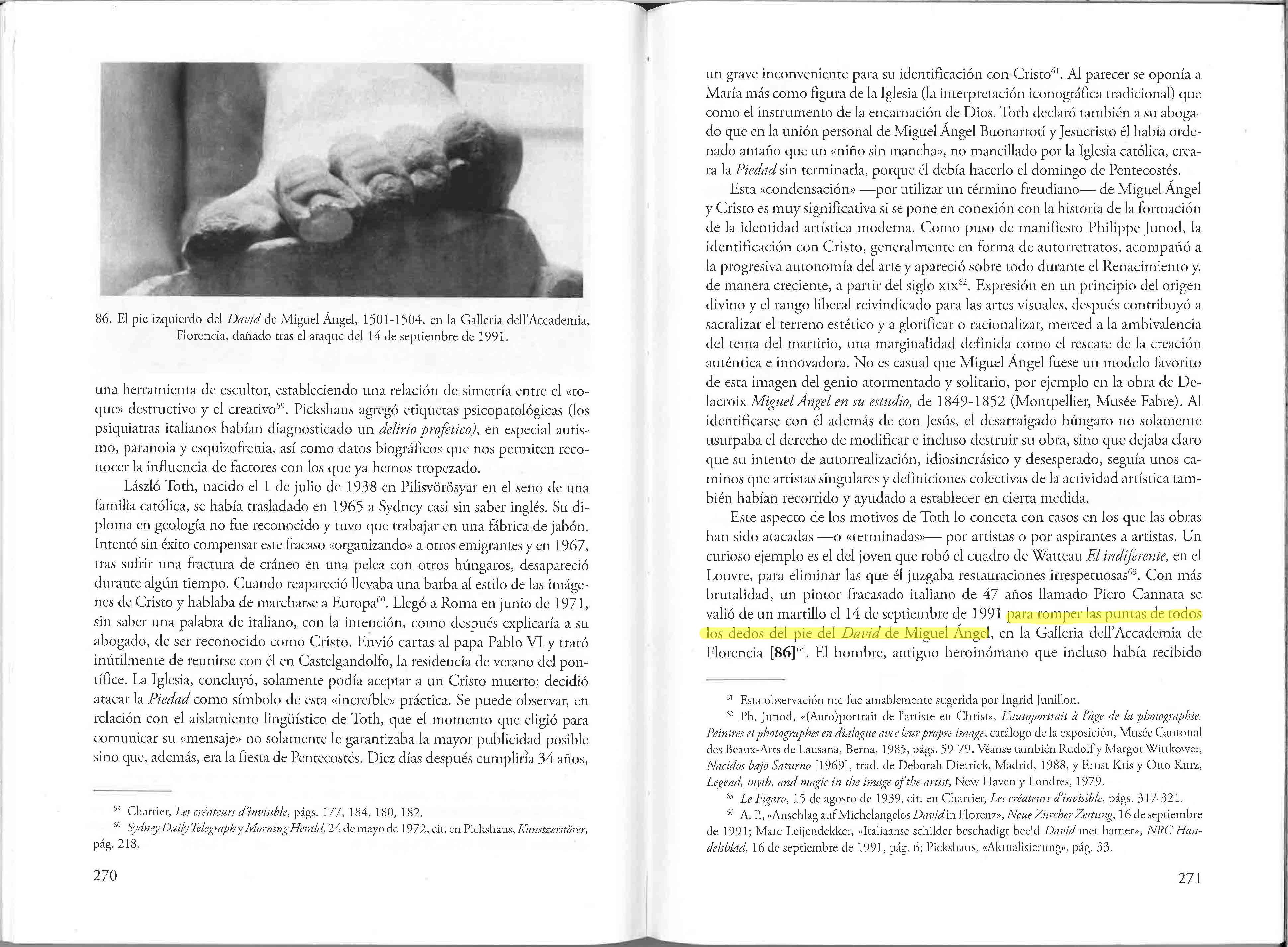
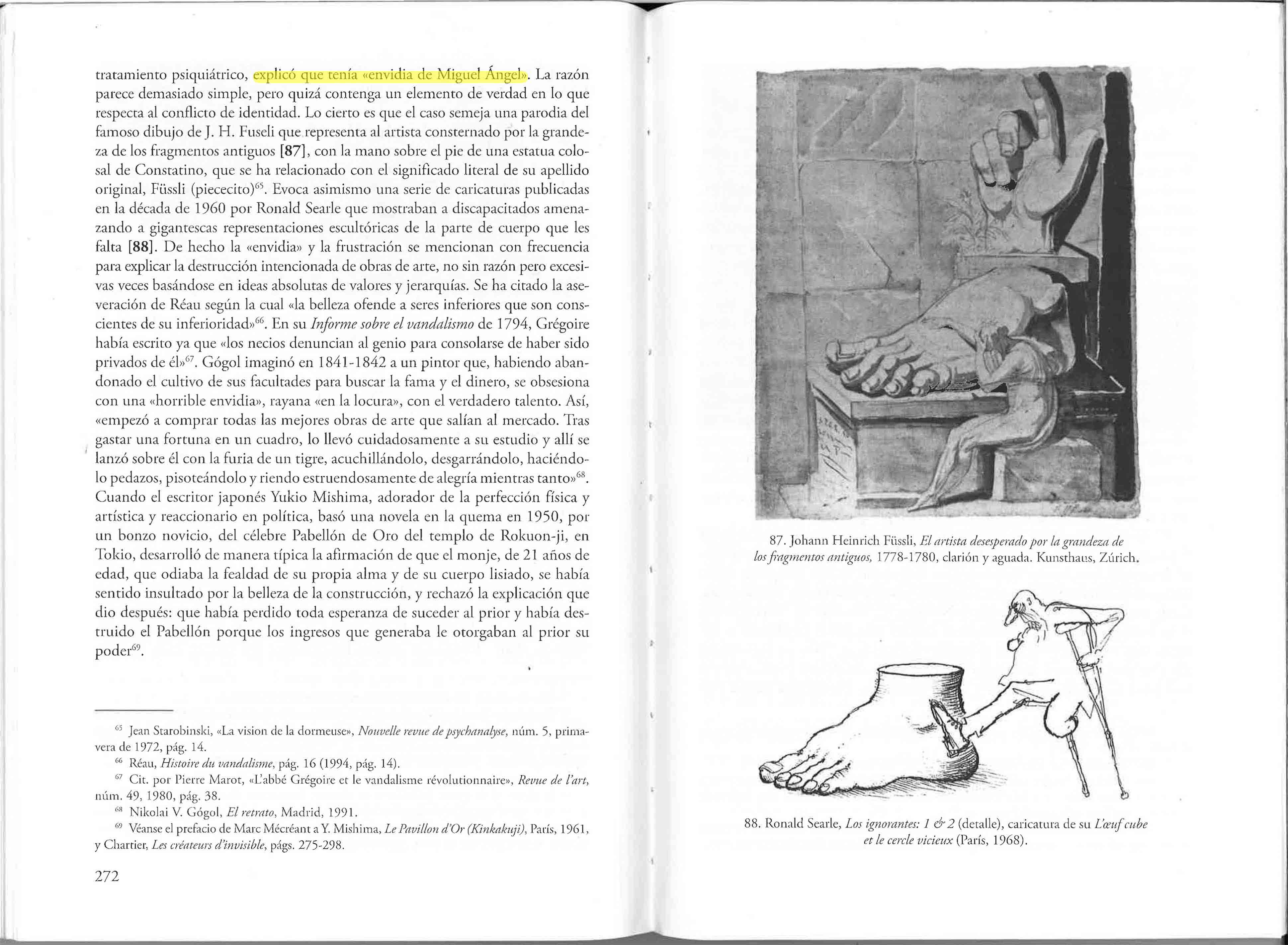
The research project intends to be a contribution to the theory of response to art, and in particular to vandalism, aligned with the two main authors: David Freedberg and Dario Gamboni. In relation to the latter author and his book The Destruction of Art[3], the publication Martellata aims to correct the errors collected regarding Cannata’s vandalistic act while providing a thorough analysis of it. Dario Gamboni, writes on pages 271 and 272 of its Spanish edition (2014): “Piero Cannata used a hammer on September 14, 1991 to break the tips of all the toes of David” […] “he was envious of Michelangelo”.
Furthermore, Martellata aims to expand the theories on artistic reception and iconoclasm with a perspective oriented to new materialisms. This focus is mainly motivated by the fact that, among other significant scientific data, relevant information for David‘s conservation was obtained after chemical and petrographic analyses of the sculpture’s fragments F3G, F17G, F18G and F19G[4]. The evidence revealed that the state of the marble of the sculpture is cotto[5] while at the same time confirmed the rumour that the block of stone which was assigned to Michelangelo came from the Fantiscritti quarry in Carrara.
Finally, as for the context of contemporary art and artistic research, the project intents to be a new view within the growing interest for vandalism that was inaugurated by Bruno Latour with Iconoclash, (Karlsruhe, 2002) and that currently concludes in Venice with the Catalan pavilion Catalonia in Venice. To lose your head (Idols). Providing an approach that generates chrono-material dialogues, it aims to be a counter-point to recent exhibitions that have a repetitive focus on iconoclasm.
–
[1] NOLAND, Carrie. Agency and Embodiment. Performing Gestures/Producing Culture. Cambridge: Harvard University Press, 2009.
[2] COHEN, Stan. ‘Property destruction: Motives and Meanings’ in Vandalism. WARD, Colin, ed. New York: Van Nostrand Reinhold, 1973. Pages 23-53. The term vandalism was coined by Abbé Grégoire during the French Revolution to designate those who destroyed the artistic heritage and / or monuments. Later on, its meaning was extended to the scope of damage to any objects as long as it could be denounced as barbarous, ignorant and inartistic treatment. Iconoclasm, which was used for the first time in Greek in relation to the quarrel of Byzantine images, implies an intention or a doctrine regarding the destruction of any images and works of art. In this application I will use iconoclasm and vandalism as synonymous and indistinctly.
[3] GAMBONI, Dario. The Destruction of Art: Iconoclasm and Vandalism since the French Revolution. London: Reaktion Books, 1997.
[4] I refer to the studies Controlli analytical and chimico-physicist sui frammenti di marmo proveniente dal dito del piede sinistro coordinated by Donato Attanasio (1991) and Caratterizzazione mineralogico petroraica e physica del marmo by Fabio Fratini (1991) that were later compiled in the book Exploring David. Diagnostic Tests and State of Conservation. Prato: Giunti Editore, 2004. pp 130-135.
[5] Marmo cotto is an Italian term to designate the marble that has lost its initial chemical-crystalline properties. This occurs when the crystals have separated over time; due to weathering, as well as a chemical and / or physical predisposition of the stone. The marmo cotto is very fragile and, in case of no intervention, it can become marmo zuccherino or dusty marble.